What Nutrition Category do you fall into?
Are you Paleo? Are you Vegan? Are you Gluten Free? Well, it is so hard to say what kind of nutrition category I fall into. I’m not entirely Paleo, I’m not entirely gluten free, I’m not entirely against all carbs. I know for sure that once I do fixate on one category and am completely strict about my diet, I tend to freak out a few weeks in and totally lose it. I end up having a worse diet than I did before.
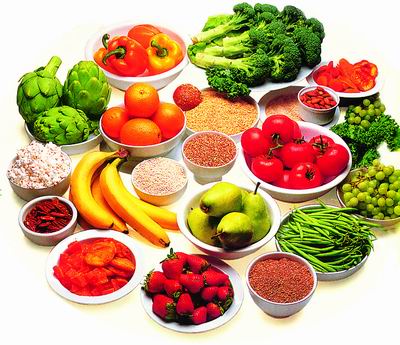
I am bringing this up because recently I read a few articles by Dr. John Berardi. He is hands down one of the best nutritionists today and all of his work is research based but also very practical. He has worked with thousands of people, elite athletes, recreational athletes, people looking to be healthier, the obese population, etc. He knows his stuff and can formulate a plan for anyone. He himself said that he can’t quite fit into a specific category when it comes to nutrition. He says that people are too different from one another and that you just cannot recommend the same diet for everyone. We all have different body types, come from different areas around the world, and have different genetic needs. Exercise, and the type of exercise, also plays a big part in what you eat and what you need nutritionally.
One of the best things that come out of dieting is that you become more aware of what you put into your mouth. What you shove into your mouth ultimately has an affect on your current body and your future body. I know that if I eat more sweets, the next day my joints hurt. This is a deduction I have finally made because of cleaning up my diet. Now, that’s not to say that I will stop eating sweets, but I am aware of it and do my best to keep the sweets to a minimum. I know that if I eat a small breakfast, I tend to be so darn hungry in the afternoon, I will eat and eat until I am stuffed, and sometimes choosing the wrong foods to fill my appetite. I have learned this through adjusting my portion sizes and the timing of my meals.
In the past I have been so reluctant to advise people on dieting, because the field of nutrition is so complex and there is not one cure all method of dieting. But what I can advise is to try things out, and take small steps to changing how you eat, because in the end, you want to change your behavior of eating, not just what you eat. So, taking it slowly will ensure your retention to change, and you wont stress out and explode. You will have, as I like to call it, “fat” days where you cheat here and there, because you socialize, go out to eat, holidays etc, but in all, you do your best in changing how you eat. For me it was the timing of my meals (trying not to eat after 6pm, eating high protein foods after workouts), eating whole foods (reducing the amount of processed foods), and eating smaller, more frequent meals (every 2-3 hours).
If you’d like more information on how to get started on a better eating regime, you should check out Dr. Berardi’s site. He offers a free 5 day course that will actually help you get started in the right direction. He breaks everything down and always gives research based info so that you can learn and know what he knows.
Here are the links to the Free 5 day courses. It’s different for men and women, so make sure you click on the right one 
Free Video Course on Fat Loss for Men
www.precisionnutrition.com/cmd.php?pageid=1539074&u=m
Free Video Course on Fat Loss for Women
Post Workout Nutrition
The other day, after running an intense climbing workout class, one of my clients asked me what the best post workout foods or
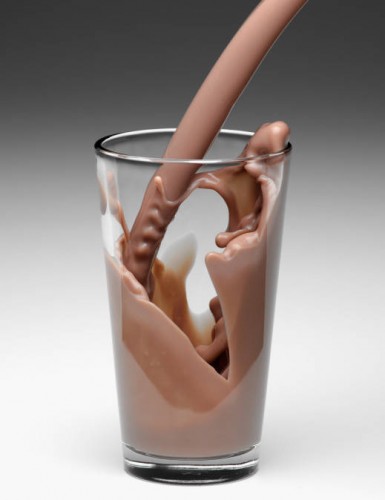 supplements are to take for recovery. My answer was Chocolate Milk! This is because it has the optimal ratio of carbohydrates to complete proteins (whey and casein).
When it comes to recovery, it’s all about eating the right ratio of carbohydrates and protein within a 30 minute period after your workout.
This is when your body is sensitive to insulin. By eating the right ratio (4:1) of carbs to protein, the better your muscles can synthesize protein, replenish muscle glycogen, reduce muscle soreness, and improve muscular strength and body composition.
According to scientific research1, whey protein and casein are two of the best complete proteins to ingest after workouts. Whey protein is fast acting and increases protein synthesis, whereas casein is slow acting and inhibits protein breakdown, both very useful mechanisms for recovery after intense exercise. Whey and casein come from milk, and can be found in other dairy products. If you are lactose intolerant, manufacturers make whey protein isolate, which is lactose free, and can often include casein.
If you prefer not to consume animal products, one of several supplements that is closest to a complete protein is Hemp protein. Your goal is to have a fast acting supplement or food after your workouts.
- Mercedes Pollmeier
Below are some other examples of the preferred ratio of carbohydrate to protein:
| Food Item | Carbohydrates (grams) | Protein (grams) |
| Non-fat chocolate milk, 8oz | 26 | 8 |
| Non-fat, fruit on the bottom yogurt, 6 oz | 28 | 6 |
| 1 mozzarella string cheese stick, 5 whole grain crackers, 10 grapes | 26 | 8.5 |
| 1 cup Cheerios® and 1/2 cup of milk | 27 | 7 |
| 1/4 cup of hummus and 1/2 cup of carrots | 15 | 5 |
| 1 slice of whole-grain bread, 1 oz turkey with mustard, and 1 cup of apple juice | 35 | 9 |
______________________________
1. Wein, D & Miraglia, M. Whey Protein vs. Casein Protein and Optimal Recovery. NSCA Performance Training Journal . 2013.
Gusher V11 – Ute Pass, CO
Galina Parfenov sends Gusher V11 in Ute Pass, CO. This is a tough one, especially the top out. Below she gives her beta for the Crux and Top Out. Great send Galina!
Crux: Shift your weight onto your left hand and lock-off while pressing hard with your right foot, then cross right hand to the undercling crack.
Topout: Using the starting rail for feet, traverse your way across the lower crack until you hit a good gaston with your right hand. Get a high right foot and bump your right hand over to a decent sidepull around the slopey corner. Move left hand to the gaston and finish on undercling crimpers.
First Female V14 (8B+) – Tomoko Ogawa
This is a very proud moment, for women in climbing and for Tomoko. It’s really great to see women from around the world, pushing their limits, staying focused, and sending their projects. Watch this great video of Tomoko Ogawa, and how psyched she is when she sends. Congrats Tomoko!
Core Strength Training
by Mercedes Pollmeier, M.S., CSCS
First of all, what is the core? Well, it’s definitely not just your abs. It incorporates most of your trunk, your back and your butt. Some exercise science specialists also say that the core can extend all the way down your hamstrings (posterior chain) and quadriceps (anterior chain). The core really is the ability to recruit as many muscles as possible to make movement as efficient as possible. By doing this, you decrease your chance of injury as well as making your body more balanced. This is why it is very important to do “core” training, or also known as full body exercises.
In climbing, when you cut your feet from the wall, what is the deciding factor to stay on the wall? Well, it’s actually a number of factors, and all are included in the “core”. In order to bring your feet back to the wall, you must have the finger strength, shoulder strength, trunk strength, lat strength and back strength to swing back on and accurately place your foot. This means training all of these things together to achieve awesomeness.
What exercises would be good for core development? Well, first of all, I believe that women in general have really good isolated ab strength. When we do crunches compared to our male counterparts, it seems we can go forever. But, when you ask us to do more integrated exercises, such as leg lifts from a bar, we fall apart. So ladies, work less on isolated ab exercises and more on integrated exercises.
My recommendations:
If you have never done ab exercises before, or have had some time off from training, or if you have a lower body injury that you are recovering from, you should start with gradual isolated ab exercises that work on the transverse abdominis and spinal muscles. This is very important to do!
Once you have done this for a few weeks, you can progress to some more difficult exercises that involve leg lifts, leg lifts with medicine balls, hanging knee raises etc.
Exercises that create a lot of tension or torque are also very important to incorporate into your regime. This is where all the muscles communicate with each other at the same time. Good examples are the front elbow plank, side elbow plank, and other really awesome varieties of the plank. To get the posterior chain, you can do hip bridges and table tops.
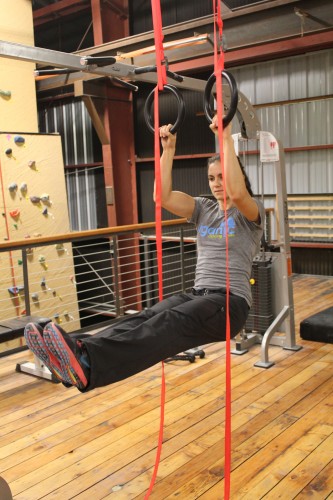
Climbing specific “core” exercises would be anything that involves hanging. Toe touches to the bar, front lever variations, windshield wipers are good examples of these.
Don’t forget! Squats, dead lifts, push ups and pull ups are also considered “core” exercises, because they involve the whole body to achieve the movement. Be safe with your exercises, take the progressions slow, and don’t push yourself to fast to achieve results. Your goal is to stay injury free as you become as strong as an OX.
For more training advice or online coaching contact info@girlbeta.com
Straight Leg Raises
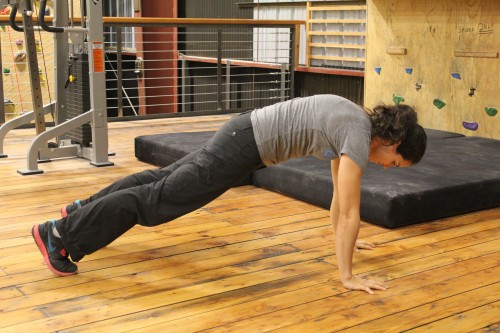
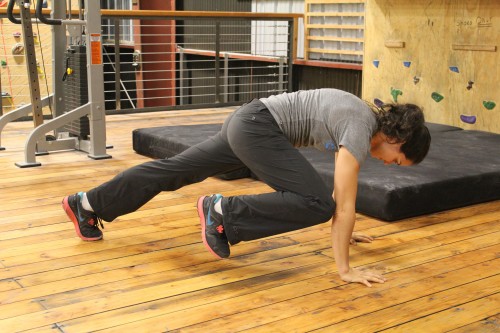
Plank Position – Knees to Elbow
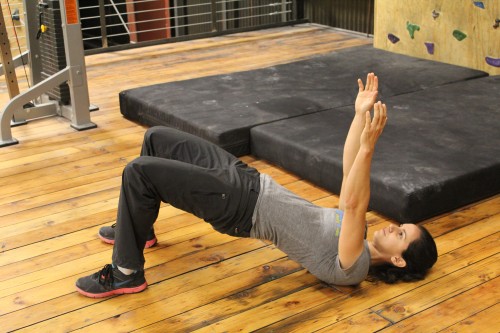
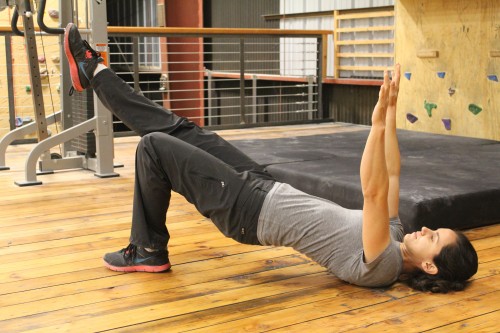
Hamstring Hip Bridge with Leg Extension
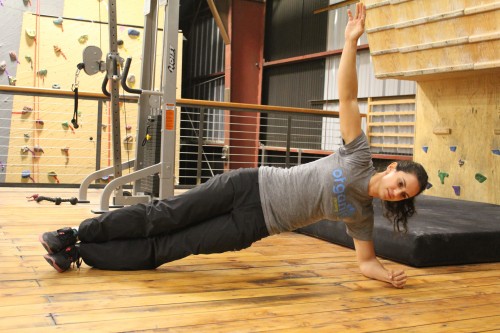
Side Elbow Plank
“On the Wall”
Here is a video about Erin Machinchick, who is a fairly new climber and offers a great perspective on what it’s like when you make climbing a part of your life. She has only been climbing for a year now and has already lead a 5.12a outside. Keep it up Erin!
“On the Wall” – A Rock Climbing Story from 5 Mile Films on Vimeo.
BKB Foundation – Getting More Kids to Climb!
Brooklyn Boulders, a gym based just outside of downtown Manhattan, is working hard to embrace their surrounding community through the act of climbing. Their latest event, dubbed Elevate The Public, is geared towards raising funds to assist with recruiting students and mentors for their City Rocks Program. This program is geared to helping inner-city youths better themselves through rock climbing and community based projects.
Many people in the climbing community talk about giving back, but this program and the members of the Brooklyn Boulders Foundation have put the wheels in motion to help expose children to rock climbing as a way to mentor them during their lives. In order to create these great opportunities for the local youths, the foundation is asking those within the climbing community for assistance.
The video below offers a better overall view of the program your donation would go to:
If you would like to make a donation to the Elevate the Public campaign you may do so by visiting http://wediditfundraising.com/campaigns/29-elevate-the-public
If you would like more information about the Brooklyn Boulders Foundation check them out at www.BKBFoundation.org
Sasha wins the Arco Rock Legend Award!
Congrats to Sasha Diguilian for winning this award. She deserves all this recognition. To view her blog and her thoughts on winning click here.

Pamela “Shanti” Pack
This woman continues to inspire me. She is one of the few climbers and possibly the only female climber trying this stuff.
Training Endurance, Strength and Power for Climbing
By Mercedes Pollmeier
If you are looking to make faster progress towards your climbing goals it is essential to include strength training into your regime. Whether you view climbing as a sport or activity, there is no doubt that a climber has to supplement their training with weight/strength training if they are looking to perform at a higher level. Look at all other sports and activities. For the most part, the athletes performing at the highest levels are also putting time in the gym to give them the edge. Strength training with weights will allow you feel stronger on routes as well as train the metabolic system required for climbing.
So, now that you are convinced that weight/strength training will help you reach your goals for climbing, you need to structure your workouts based on the season and time period you have for reaching your goal. Remember, make attainable goals, and continue to make new goals as you progress.
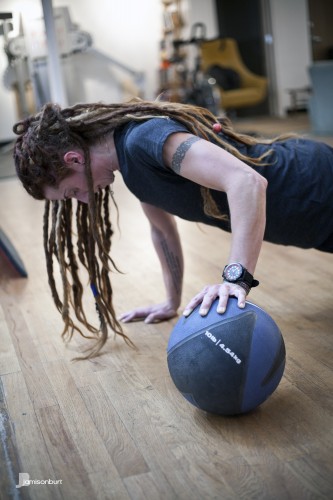
Rochelle doing push up variation
To start a solid training regime, you need to follow the progression of endurance, strength and power. This not only helps you peak for your project/season, but it also keeps you from getting injured. You also need to keep in mind that climbing also incorporates the lower body. It always surprises me that when I see a climber working out, they are sooo focused on ab and arm training. Your legs are part of your core, and are the base of support as well as the initiator of movement. So, make sure to include lower body exercises as well! (* A note for female climbers – we tend to suffer from the Q angle syndrome, which means that we have a very high chance of tearing our ACL’s. By training proper lower body mechanics, we can function better and avoid the chances of lower body injury. Mostly it’s the knee and hip movement that we need to keep an eye on)
Below is a sample of a strength workout. This is purely just the weight-training component. This does not include other important aspects that need to be incorporated into your training regime such as campus board, systems wall and cardio workouts. Other climbing specific exercises such as front levers, rope climbs, hanging legs raises etc, can also be incorporated into this program. The exercises selected are basic body movements that work the large muscle groups that will no doubt help you climb harder and function better.
Here is a sample progressive workout. This can be done 2-3 days a week. Work into it slowly! In addition to this, you can choose to take active rest periods. This is generally done every 4th week of the training program. You can still climb during this period, but try to keep the volume low. All physical adaptations from training occur during the recovery period!!
Endurance (3-6wks): 3-6 sets, 10-20 reps (you gotta feel the burn!), 30s-1min rest in between.
Body Weight (BW) squats
BW single leg squats
Hamstring extensions on the ball.
Pull ups *(50-75% 1RM)
push ups (50-75% 1RM)
Dumbbell chest press (50-75% 1RM)
Plank
Jump rope (considered plyometric, but great for building those calf muscles, do 5-15mins)
Strength (3-6Wks): 3-5 sets, 4-8 reps, 30s-1min rest. Weight selected should be progressed from 75-90% 1RM.
Squats
Straight leg dead lift
Weighted pull ups
Weighted push ups
Weighted dips
weighted single leg squats
Windshield wipers
Weighted plank
Cable rows
Box jumps (1ft height, ~25 reps)
Power (3-6wks): 1-3 sets, 1-5 reps, 1-3min rest. Weight selected should be progressed form 80-95% 1RM)
Power clean
Squat to overhead press
weighted pull ups
weighted push ups
Dumbbell chest press
Bent over rows
box jumps (2ft height)
* 1RM means the maximum weight you can lift once. i.e. if you can chest press 100lbs, your 50%1RM would be 50lbs. If you can only do 1 pull up, use a bungee or resistance band to help you do more reps.



Analytics Plugin made by VLC Media Player